From Corporate Strategy to Grief Advocacy, Colleen Coleman is Changing How We Understand Loss
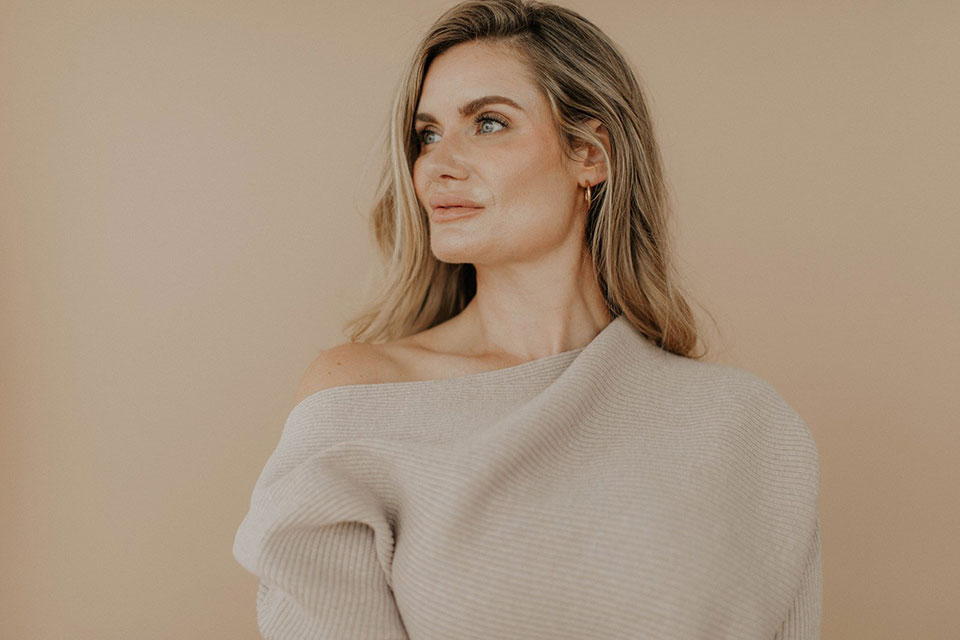
Founder, Celebration of Life Studios · Psychic Medium · Grief Advocate · Trained End-of-Life Doula · Thanatology Student
My dad died in 2014. I was twenty nine. He drank himself to death, our relationship was not in a good place when it happened, and I carried a lot of shame about both of those things for a long time. What followed was twelve years of me trying to solve grief the way I solved everything else, which is to say aggressively and expensively.
I trained for and ran the inaugural Tahoe 200, one hundred eighty six and a half miles, because some part of me believed that if I could manufacture the most physical pain imaginable it would cancel out the other kind. It did not. I ended up in the hospital. I ran across the Grand Canyon. I read every book ever written on what happens when we die. I did forty nine ayahuasca ceremonies. I went to Mongolia to study with shamans. I took up mountaineering, which I hated, for the sole purpose of climbing the mountain my father had climbed so I could carry his photo and some of his ashes to the summit. I hired a business coach, an astrologer, and a Reiki practitioner. I sat with a medium who was not ethical, which is its own kind of injury and is why I am now relentless about integrity in this field. I changed jobs, then careers. I got divorced. I built a real estate investing business on the side mostly so I would have somewhere to put my attention at two in the morning.
Somewhere around year ten I sat down and added it up. Twelve years. One hundred eighty six and a half miles. Well over a hundred thousand dollars. And what I had at the end of it was a roadmap. An actual, working roadmap back to freedom, function and peace.
That was the moment. Not because I was proud of the roadmap, but because I was furious that I had to build it myself. Nobody should have to spend a decade and six figures reverse engineering something our culture used to hand people for free, in the form of ritual and community and a plan. I had spent twenty years in brand strategy learning how to take something complicated and make people understand it. I realized I was holding the most important assignment of my career, and it had been sitting in my own life the whole time.
Q: You have described your brand, Celebration of Life Studios, as essentially building the room you once needed yourself. What was missing from the way our culture responded to your grief that ultimately became the foundation for the company?
CC: Three things were missing, and I can name all of them now.
The first was a plan. I grew up on forty acres in the middle of nowhere. We raised our own meat, and we hunted, so death and harvest were ordinary to me. But my father's death was not ordinary, and I had no framework for it. I remember being genuinely jealous of people with religion, not for the theology but for the logistics. They got a sequence. Say this prayer, sit for this many days, light this candle on this date every year forever. I got a casserole and about nine days of grace before people started using the phrase moving on.
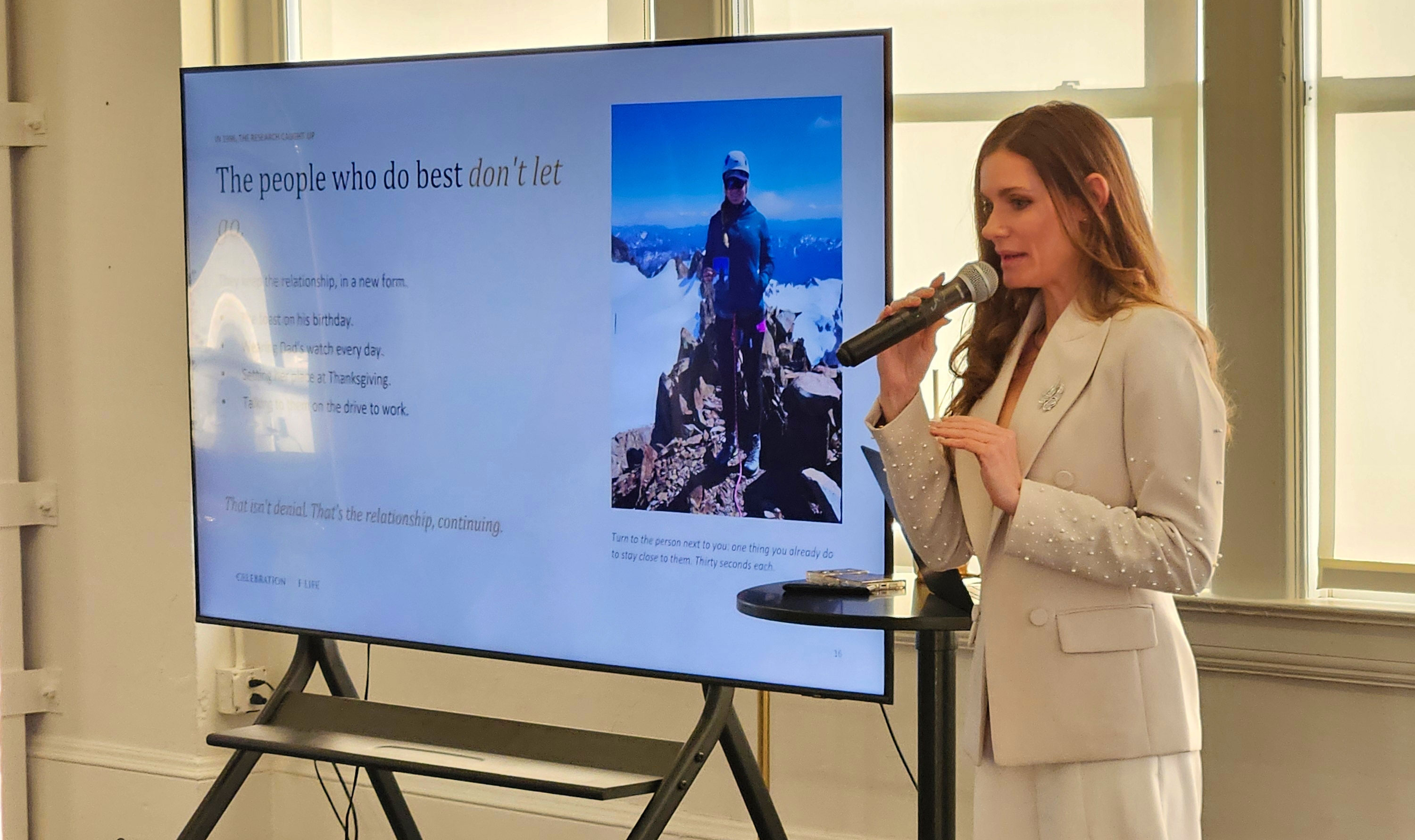
The second was permission to keep the relationship. Researchers have shown for thirty years that the bond with someone who died does not end, it changes form. They call it continuing bonds. Almost every culture on earth has known this forever. In Mexico families build ofrendas and welcome their people home for Dia de los Muertos. In Japan, Obon lanterns guide ancestors back each summer. In Jewish tradition, families light a yahrzeit candle on the anniversary and say Kaddish and Yizkor. Here in North America, we were handed a vocabulary of closure, letting go, and moving on, all of which quietly instruct the griever that the ongoing love is a symptom. It is not a symptom. It is the point.
The third was infrastructure. When someone dies you do not just need emotional support. You need an estate attorney, a financial advisor, a tax professional, a realtor, a moving company, possibly a death doula, possibly a grief counselor, and for a lot of people, something spiritual. None of those people know each other. None of them hand you to the next one. You are expected to assemble a fragmented industry from scratch on the worst week of your life.
Celebration of Life Studios exists because all three of those gaps are solvable. We are building the plan, the permission, and the infrastructure in one place.
Q: You could have created a nonprofit, a counseling organization, or simply an annual event. Instead, you are building Celebration of Life Studios as a media and community company. Why was that model important to you, and what do you ultimately envision it becoming?
CC: Because the problem I am actually trying to solve is a narrative problem, and you do not fix a narrative with a service. You fix it with story, at scale, repeatedly, until the culture moves.
A counseling organization serves the people who walk through the door. That work matters enormously and I am not diminishing it. But the reason people are suffering unnecessarily is not a shortage of counselors. It is that we are all operating off a script that tells us grief is a private medical event with a reasonable end date. That script gets rewritten by media, by rooms full of people, by a public figure saying the unsayable thing out loud. Not by a brochure.
A nonprofit would have capped it. I would have spent the next five years writing grant applications and reporting to funders instead of building the thing. So, we structured as a public benefit company, which puts the mission in the corporate charter legally, and keeps the growth engine intact. We can move at the speed of a company while being accountable to the mission like a nonprofit.
What I ultimately envision is a platform where a grieving person lands and is met by everything and everyone, they need, from the practical to the spiritual, without having to explain themselves twice. Around that platform sits a media arm, a podcast, a membership, digital education, retreats, and live events like Celebration of Life Seattle. I am also building a business studio for the non-clinical practitioners in this industry, the death doulas and end-of-life professionals and mediums, because right now they are wildly undersupported as business owners and this whole field rises or falls on whether they can stay in business.
The honest long game is this. I want grief literacy to be as unremarkable as financial literacy. I want a version of this culture where nobody has to do what I did.
Q: You often use the phrase grief literacy. What does a grief-literate society actually look like? What would we say, do, or understand differently if we became better at talking about loss?
CC: It is easier to describe by what stops happening.
In a grief-literate society, we stop saying at least. At least he is not suffering. At least you had so many years. At least is a sentence people reach for when they are uncomfortable, and it always, always functions as a request for the grieving person to stop.
We say the dead person's name. Out loud, casually, months and years later, without lowering our voice. The number one thing grieving people tell me is not that the loss is unbearable. It is that everyone acts like the person never existed, and that second loss is often worse than the first.
We ask better questions. Not how are you doing, which is unanswerable, but tell me about him. What did he sound like. What would he have said about this. Those questions are gifts.
We understand that grief is not depression, and we stop treating normal grief as a disorder to be medicated out of the room. We also understand the reverse, which is that some grief does become complicated and does need clinical care, and we get better at knowing the difference.
Institutionally, it looks like bereavement leave that is not three days. Three days is an insult dressed as a policy. It looks like schools teaching children about death before a child in that school dies. It looks like employers who understand that the person who lost their mother in March is still grieving in November and is not underperforming, they are grieving.
And it looks like ritual. We gutted our rituals and replaced them with nothing. A grief-literate society builds new ones. That is a lot of what we are doing.
Q: With your events and conferences, how do you design it centered around death and grief so that it feels beautiful, human, and even life-affirming without trivializing the pain people may be bringing into the room?
CC: The first rule is that nobody has to perform being okay, and nobody has to perform being devastated either. Both are exhausting. The day is built so you can walk in carrying whatever you are actually carrying and not be managed.
Structurally, we sequence it. The day opens with invited speakers giving real testimony about someone they loved and lost. Not motivational talks. Testimony. Then researchers and clinicians share what actually helps, because I refuse to build a day that is only feeling and no substance. Then practitioners from across end-of-life care are present in the room with genuine support, so that if something opens up in you there is somewhere to take it before you drive home.
The day closes with an Evening of Mediumship, where trained evidential mediums share specific, recognizable details about people who have died. Names, habits, inside jokes, the way someone laughed. That is what evidential mediumship is, and it is not a performance, and it is not fortune telling. For a great many grieving people, it is the first time they have felt permission to keep talking about their person out loud in a room that does not flinch. People of every faith and of none are welcome, and plenty of people arrive as skeptics, which is completely fine.
The aesthetic choices matter more than people expect. Beautiful room. Good light. Waterfront. Real food. Volunteers we call Angels whose only job is to make it feel like someone is holding the door for you. Grief is not made more respectful by being made uglier. The ugliness of the average funeral home is not reverence, it is neglect.
And there is joy in it, because there is joy in the people we lost. We laugh in that room. A day about death that has no laughing in it is not honest about what love is actually like.
Someone gave me a line recently that has become our battle cry. Grieving out loud is an act of rebellion. That is the feeling we are designing for. Not a sad room. A defiant one.
I will also tell you something I did not plan and could not have planned. October 10 is my birthday. I will turn forty two on the day we open those doors. I did not choose the date for that reason, it came down to venue availability, and I did not notice until it was already locked. I have stopped arguing with things like that.
Q: What is one word of advice you can offer to young women who want to reach your level of success?
CC: Stop waiting to feel chosen.
I spent years as a corporate baddie in heels who looked entirely put together and felt completely confused, waiting for someone with more authority than me to tap me on the shoulder and confirm that I was allowed. That tap does not come. Or it comes twenty years late, after you have already done the work, and by then you realize you were the authority the whole time.
The women I watch build real things are not more confident than everyone else. They are just willing to start before the confidence shows up.
Q: Can you tell our audience one of your most memorable moments of your career?
CC: Standing in front of a room and saying, out loud, that my father drank himself to death and that our relationship was a mess when he died.
I had never said that in public. I had spent a decade managing the sentence, softening it, finding ways around it. And when I finally said it plainly, I watched a room of a hundred people exhaling at the same time. Afterward the line to talk to me was not about mediumship. It was person after person saying some version of mine too, and I have never told anyone that.
That was the moment I understood what my actual job is. It is not to be impressive. It is to go first.
Q: At the start of your career, what do you wish you had known?
CC: That the thing I thought was my liability was going to become my entire body of work.
For years the most interesting parts of me, the intuitive parts, the parts that could read a room before anyone spoke, were things I actively hid at work. I thought they were unprofessional. It turns out that was the skill. Twenty years of brand strategy taught me how to translate, and the thing I was born able to do is perceive. Those two together are the whole business.
I also wish someone had told me that career paths are not ladders, they are compost. Nothing you do is wasted. My corporate years, my real estate years, my time in rooms I felt like an imposter in, all of it is load bearing in what I do now.
Q: Which woman inspires you and why?
CC: My best friend, who died of breast cancer in 2023.
She was the most alive person I have ever been around, and she stayed that way through a diagnosis that would have made anyone smaller. She did not get spiritual about it or brave about it in the way people expect. She got honest. She said the true thing about how bad it was, and then she went and made her life ridiculous and beautiful anyway, right up to the end.
What she taught me is that you do not have to resolve something in order to live fully inside it. I think about that every single day in this work. People come to me wanting grief to be finished. She is the reason I can tell them the truth, which is that it does not finish, and that is not the tragedy they think it is.
Q: What advice would you give to young women who want to pursue their dream and start a business?
CC: Price for the outcome, not for your hours, and start the day you start.
The single most expensive habit I see in women building businesses is trading time for dollars and then quietly resenting it. Your price is a signal. It tells the market what the transformation is worth, and it tells you what you believe about your own work. Undercharging does not make you generous, it makes you unavailable, because eventually you burn out and disappear on the exact people you meant to serve.
And build the thing in public while it is still ugly. I am building an entire company in real time in front of an audience. It is uncomfortable and it is also the only reason it is moving this fast.
Q: What advice would you give to young women who want to succeed in the workplace?
CC: Get specific about what you actually want, because vague ambition is very easy for an organization to absorb and ignore.
Most people say they want to grow. Almost nobody walks in and says, I want that role, here is what I have done, here is the timeline. The second version is uncomfortable to say, and it works.
Also, learn to tell the difference between a room that is hard and a room that is harmful. Hard rooms build you. Harmful rooms just cost you, and there is no prize at the end for how long you stayed.
Q: After high school, where did you feel your career path would take you?
CC: Honestly, anywhere with a sidewalk.
I grew up on forty acres in the middle of nowhere. My entire ambition was legible to me as leaving. I went into corporate brand strategy because it looked like the furthest possible thing from where I came from, and for twenty years it was a genuinely good fit.
If you had told eighteen year old me that I would end up working in death, dying and bereavement, running an event on the Seattle waterfront, and finishing a master's in thanatology, I would have assumed something had gone terribly wrong. It turns out the girl who grew up around harvest and hunting, and the ordinary fact of death had the right education the whole time. I just took the scenic route back to it.
Q: Can you tell us how you manage your work life balance?
CC: I am going to answer this honestly rather than aspirationally, because I think women get lied to about this constantly.
Right now, three weeks out from a major event and in the middle of a graduate program, my balance is not good. It is a season and I named it as a season, which is the actual discipline. I build my roadmap in stretches of push and stretches of rest, on purpose, and I label them. Launches and events and visibility sprints are push. The months after are rest, where the revenue comes from things that are already built rather than things I am cranking out.
The non-negotiables inside a push season are small and they hold. A morning practice before anything else. My three border collies, who do not care about my calendar and require me outside daily. And the water, because I live on it.
What I do not do anymore is pretend that every week can be balanced. Some weeks are a push. The trick is making sure the push has an end date you actually honor.
Q: What's your advice for women in male-dominated fields?
CC: Do not spend your energy becoming legible to a room that was not built for you. Spend it becoming undeniable.
I spent two decades in corporate rooms learning to round off my edges, my intuition, my directness, the parts of me that made people shift in their seats. It bought me approval and it cost me time. The things I was sanding down were the things that make me good at this.
Also, be excellent at the unglamorous part. Know the numbers better than anyone in the room. It is very hard to dismiss a woman who has the actual data.
Five Things About Colleen Coleman
1. Which of the five senses would you say is your strongest?
Hearing, and not in the way most people mean it. I am a medium, and the information I get most reliably arrives as sound. A phrase in someone's voice, a nickname, the specific way a person said a word. I also hear the thing underneath what people are saying out loud, which is occasionally inconvenient at parties. My astrologer and my Human Design chart both flagged this long before I was willing to admit it was a job qualification.
2. What's the most amazing adventure you've ever been on?
In 2017 I climbed the mountain my father had climbed, carrying a photo of him and some of his ashes strapped to my pack. I genuinely hate mountaineering. I took it up for exactly one reason. Getting to the top and leaving part of him there is the most amazing and most difficult thing I have ever done. A close second is going to Mongolia to study with shamans, which is a much longer story and involves a lot more horse.
3. What were you like in high school?
I grew up on forty acres in the middle of nowhere. We raised our own meat and we hunted, so I was a kid who was entirely comfortable with things city kids find alarming, and entirely uncomfortable with the fact that the nearest anything was a long drive away. I was ambitious in a way that had nowhere to go yet. My whole plan was to leave. Preferably somewhere with a sidewalk.
4. What would your perfect Saturday be like?
Up early, because I am hopelessly a morning person. Coffee and my practice before I look at a single screen. A long walk on the water with my three border collies, who started as fosters and then simply never left. Then cooking something involved for people I love, at a table that runs too long, where somebody brings up someone who died and nobody changes the subject. That last part is the whole point of my life's work, and it is also just my favorite way to spend an evening.
5. What's your favorite quote or saying?
Grieving out loud is an act of rebellion. It came out of a podcast conversation recently and it has quietly become the battle cry for everything we are building.